
Coronal composition
Observing and modelling coronal EUV plasma composition and first ionisation potential bias in active regions and flares.
Cursor instrument
Overview
I am a solar physicist specialised in EUV spectroscopy at ESTEC in Noordwijk, Netherlands. My passion is to study how plasma composition and non-thermal line broadening evolve through solar activity, especially in active regions and flares. Before joining ESA in 2023, I completed a PhD in Solar Physics at Mullard Space Science Laboratory, University College London.
Current themes
Coronal composition
Observing and modelling coronal EUV plasma composition and first ionisation potential bias in active regions and flares.
Flare spectroscopy
Spectroscopic signatures of flare precusor and flare evolution.
Featured work
Science highlight
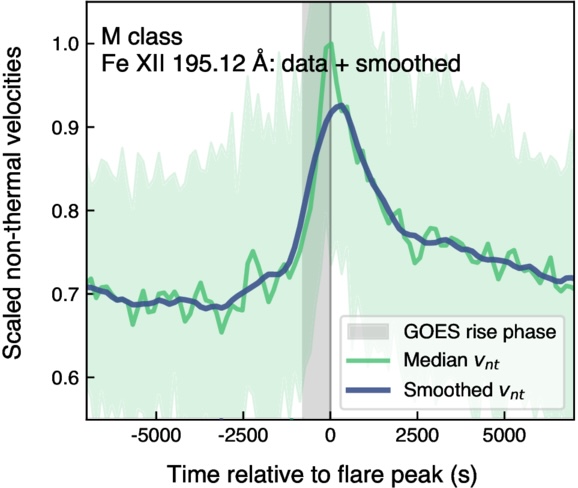
AAS Nova featured the 2025 paper on non-thermal velocity increases before flare onset. The article summarises how a large Hinode/EIS sample shows that line broadening often begins several minutes before soft X-ray start, and discusses how precursor emission differs between confined and eruptive flares.
Paper figure
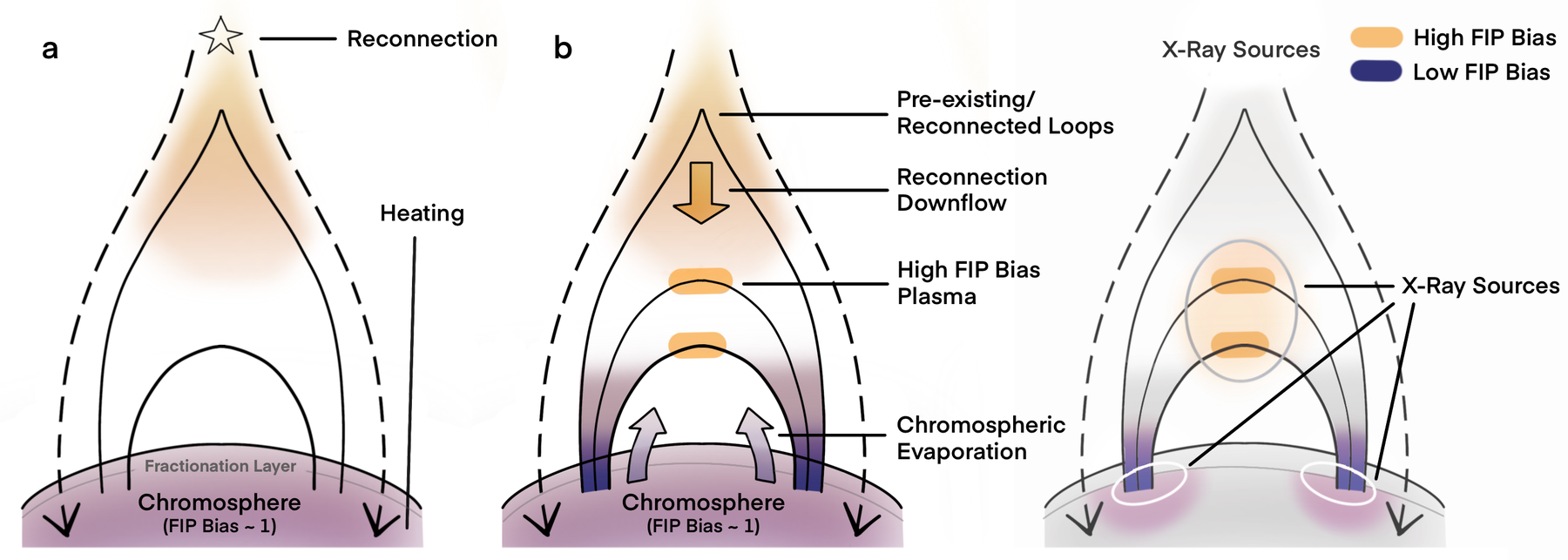
This illustration from To et al. (2024) summarizes the interpretation proposed for the 2017 September 10 flare: low-FIP-bias chromospheric evaporation fills the lower flare loops, while high-FIP-bias plasma from reconnection downflows remains concentrated near the loop top.
Current
Systematic non-thermal velocity increase preceding soft X-ray flare onset.
The Astrophysical Journal, 2025.
Chromospheric dynamics and turbulence regulate the solar FIP effect.
Philosophical Transactions of the Royal Society A, accepted.
Solar Orbiter, Hinode, and IRIS
Co-observation coordinator, 2024-present.
IRIS
Planner, 2024-2025.
JVLA S-band programme
PI for observations on the correlation between solar abundances and F10.7 radio emission.
Joint observations with GREGOR, SST, IRIS, and Hinode.
CV
2023-present
European Space Agency
Research Fellow in Space Science, ESTEC, Noordwijk.
2019-2023
University College London
PhD in Solar Physics, Mullard Space Science Laboratory.
Thesis: "Coronal Plasma Composition Evolution and Solar Activity".
2018-2019
King's College London
Master's degree in Theoretical Physics.
2015-2018
Imperial College London
Bachelor's degree in Physics.
Publications
2026 · First author
Nonthermal line broadening at solar flare footpoints is primarily field-aligned
Summary
Using 4,593 Hinode/EIS spectra from 407 C- to M-class flare footpoints, this paper tests whether non-thermal line broadening is field-aligned, isotropic, or transverse. It finds that coronal line widths decrease from disk center to limb, indicating a primarily field-aligned broadening component, while cooler lines retain decay-phase broadening and hotter lines show a rapidly decaying impulsive component consistent with ion heating and anisotropy.
2026 · First author
Chromospheric dynamics and turbulence regulate the solar FIP effect
Summary
Coronal elemental abundance patterns (FIP bias) encode chromospheric physics. Coupling HYDRAD chromospheric simulations with the ponderomotive-force code FIPpy, we show the ponderomotive model remains viable under dynamic heating, while acoustic flux and turbulence strongly reshape fractionation: very low acoustic flux lets thermal velocities dominate and produce unusual element ordering, whereas turbulence—including enhanced turbulence in flares—suppresses fractionation and may explain weaker FIP bias observed during flares.
2025 · First author
Systematic non-thermal velocity increase preceding soft X-ray flare onset.
Summary
Using a Hinode/EIS catalogue of 1,449 flares from 2011-2024, this paper measures how EUV non-thermal velocities evolve before soft X-ray flare onset across C-, M-, and X-class events. It finds that line broadening typically begins 4-25 minutes before GOES start in C and M flares, with earlier and more extended precursor behaviour in many eruptive M-class events.
2024 · First author
Summary
This paper tracks FIP bias through the 2017 September 10 X8.2 flare using 12 Hinode/EIS rasters and two abundance diagnostics. It finds persistent high-FIP-bias plasma near loop tops and near-photospheric values at footpoints, consistent with mixing between reconnection-downflow plasma and chromospheric evaporation.
Summary
This paper tests why the Sun-as-a-star correlation between coronal composition and F10.7 becomes nonlinear during higher activity. Using coordinated JVLA, Hinode/EIS, and SDO observations, it shows that strong magnetic concentrations and gyroresonance above sunspots alter the local relationship between radio flux and coronal abundance.
A fuller publication record is available on the publications page, through the ADS library, ORCID, and the PDF CV.
Activities